At a Glance
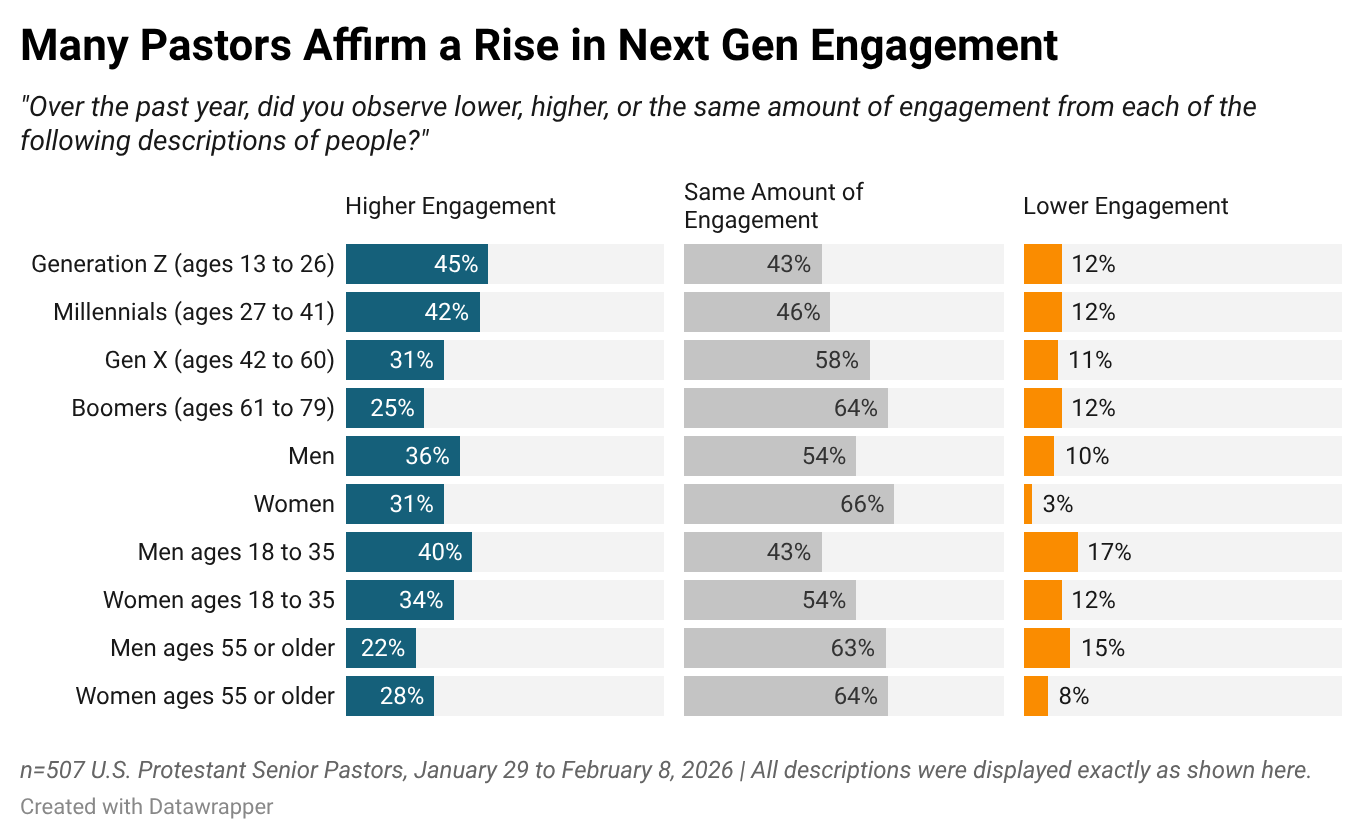
- Two in five senior pastors say their church has experienced higher engagement among Gen Z (45%) and Millennials (42%).
- Forty percent of pastors report increased engagement among men ages 18 to 35.
- Larger, non-mainline churches led by younger pastors are most likely to report rising engagement among young adults.
Barna’s 2025 findings showed rising spiritual curiosity—greater openness to Jesus, increased Bible reading and more faith commitments—among younger generations. Beyond mere curiosity, this trend should lead to tangible church engagement: serving, joining small groups and deeper participation. Are younger adults moving from being curious about faith to actively engaging in church life?
To explore that question, Barna surveyed 507 Protestant senior pastors from both mainline and non-mainline churches. We asked whether, over the past year, they had observed lower, higher or about the same level of engagement by specific generations, gender and age groups based on what engagement looks like in their church context.
In many churches, pastors say younger generations are leaning in. Two in five senior pastors say their church has experienced higher engagement among Gen Z (45%) and Millennials (42%), while most pastors say Boomers and Gen X have stayed about the same.

“For decades, church leaders have reported significant obstacles to reaching younger generations,” says David Kinnaman, CEO of Barna Group. “But something is shifting in what senior pastors are experiencing. Many are now reporting increased engagement among Gen Z and Millennials. Pastors are nearly twice as likely to report increased engagement among Gen Z as among Boomers. And reported engagement among Millennials is 35 percent higher than engagement among Gen X.
“The research paints a wide-ranging picture of churches, with many growing younger, some stagnant and about one in ten experiencing overall decline. These findings point to an uptick in younger congregants, but that is not a universal experience of pastors.”
What Kinds of Churches Are “Growing Young”?
As shown in the chart below, non-mainline churches outpace mainline churches in reporting growth among Gen Z and Millennials. Large churches—both in terms of size and budgets—also report much stronger growth curves among younger audiences.
Younger pastors are more likely than are those over age 45 to report increased engagement among both Gen Z and Millennials. Interestingly, churches in the West, followed by leaders in the Northeast, are slightly ahead of those in the South and Midwest in terms of increased engagement, especially among Gen Z.

Young Men Show the Most Divergent Engagement Trends
One of the most intriguing findings concerns engagement among young adult men. In the first chart, 40 percent of pastors say engagement among men ages 18 to 35 has increased. At the same time, a significant share report decreases (17%).
This makes young men the demographic group for which pastors report the most divergent experiences—more than young women, older men or older women.
“Young men represent one of the most mixed patterns we’re seeing among pastors,” says Kinnaman. “Some churches are experiencing a real increase in engagement among them, while others are seeing the opposite.”
Church context appears to play an important role in shaping these experiences. Non-mainline churches are far more likely than mainline churches to report increased engagement among young men (47% compared to 17%). Larger churches—especially those over 500 attendees—and younger pastors are also more likely to report increased engagement among young men. Again, church leaders in the West report higher engagement among men, while churches in the Northeast are least likely to report such experiences.

A Wide Range of Experiences—And Signs of Momentum
The findings reveal a complex picture. Across the country, pastors report a range of realities. Some describe declining engagement. Others see little change. And, as Kinnaman notes, “In some churches, leaders are experiencing a real on-the-ground bump in next generation engagement.”
What makes these findings significant is not that engagement is rising everywhere. It clearly is not. Rather, the data suggests that in a substantial number of churches, pastors are seeing real signs of renewed interest and participation among younger generations.
In many congregations, younger adults are not only expressing curiosity about faith—they are attending, participating and leaning more fully into the life of the church.
The story of the next generation and the church is still unfolding. But according to pastors across the country, signs of new engagement are beginning to appear.
Share
About the Research
This study is based on a survey of 507 U.S. Protestant senior pastors from mainline and non-mainline churches. Pastors were asked whether they had observed lower, higher or about the same level of engagement over the past year among various generational, gender and age groups.
The survey did not provide a formal definition of “engagement.” The term was used in its common ministry sense, allowing pastors to interpret it according to their local context. While engagement is often associated with church attendance, it may also reflect broader participation in church life, such as volunteering, small group involvement or spiritual responsiveness.
Because engagement was not narrowly defined, findings reflect pastors’ overall perceptions rather than a single measurable metric.